The Myth of the Weak Lead Shoulder — and How Elite Golfers Actually Create Whip Speed
If you freeze a still image of Tiger Woods’ swing from his peak speed era in the late 1990s, you might think something looks wrong.
His lead shoulder appears to protract early.
His lead arm looks long—almost too long.
To the untrained eye, it can look weak.
It isn’t.
What you’re seeing is one of the most misunderstood — and most powerful — movements in elite golf: a rib-driven elastic load that allows the arms to stay passive until the exact moment the club must be released.
This is not something you can learn from positions.
And it’s not something most instruction systems can even detect, let alone teach.
That’s exactly why GOATY exists.
Why the “Weak Lead Shoulder” Is a False Diagnosis
Most golfers have been taught one of two flawed ideas:
- “Keep the lead shoulder back and tight”
- “Or… reach the club away to create width”
Both approaches miss the truth.
Elite players do neither.
In Tiger’s speed-dominant era, the lead shoulder appears to protract early because the rib cage rotates and side-bends first. The scapula is not shoved forward. It simply rides the ribs as the torso turns.
This distinction matters more than almost anything else in the swing.
- ❌ Protracting the shoulder independently = instability, weakness, injury
- ✅ Rotating the thorax and letting the scapula move with it = elastic strength
The scapula is a passenger, not the driver.
GOATY is built to recognize that difference.
The Real Role of the Lead Arm (It’s Not Power)
In elite swings, the lead arm does not create speed.
It provides early containment.
At setup and in the early backswing, the lead arm:
- Feels long and heavy
- Is supported by the chest, not pulled across it
- Acts as a temporary stabilizer to prevent early trail-arm activation
This is critical.
If the trail arm fires too soon, the swing becomes a push. Speed is lost. Timing collapses.
The lead arm’s quiet stability allows the body to load elastically first.
GOATY teaches this not by telling golfers to “hold positions,” but by training pressure awareness and sequencing so the arms never outrun the torso.
The Moment Everything Changes: The Mid-Swing Hand-Off
Here’s where elite swings separate from good ones.
At roughly halfway back, something subtle but profound happens:
Pressure transfers into the trail hand — specifically the middle fingers.
Not the palm.
Not the thumb and index.
The middle fingers.
This pressure pattern connects directly into the trail forearm, lat, and fascial sling that powers the release. At this moment:
- The lead arm is still long
- The club is now supported by the trail side
- The golfer has not “hit” anything yet
This is the hand-off point.
GOATY is designed to detect when this hand-off occurs — and whether it happens too early, too late, or not at all.
Most golfers never experience it.
The “Flick” That Everyone Warns You About (But Elites Rely On)
Near the bottom of the swing, elite players often report a sensation that scares instructors:
“It feels like the club gets thrown… almost like a little wrist flick.”
This is where bad instruction has done real damage.
That “flick” is not an action.
It is a release.
When the body unwinds correctly, and the trail arm extends at the right moment, the wrists unhinge because physics demands it. The clubhead overtakes the hands due to angular momentum — not because the golfer tried to flip it.
Every great striker in history felt this.
The difference?
They never did it.
GOATY doesn’t teach golfers to “hold lag” or “release the club.”
It teaches them to sequence the sling so the release happens on its own.
Why Tiger Changed After 2004 — and Why That Matters
Tiger Woods didn’t abandon this system because it was wrong.
He changed it for control and durability.
Post-2004:
- His lead scapula became more set at address
- Thoracic motion became more constrained
- The trail arm engaged earlier
He traded raw elastic violence for repeatability under pressure.
That choice won majors — but it reduced the extreme whip speed of his earlier years.
Most golfers today are taught a watered-down version of this later model without ever learning the elastic foundation that made Tiger special in the first place.
GOATY teaches the foundation first — safely.
Why This Can’t Be Taught With Positions or Video Alone
Here’s the uncomfortable truth:
If a golfer tries to copy what this looks like without the correct rib cage mechanics, they will collapse, disconnect, or injure themselves.
That’s why GOATY doesn’t teach:
- “Protract your shoulder”
- “Reach the club away”
- “Keep your arm across your chest”
Instead, GOATY trains:
- Rib-first rotation
- Arm passivity
- Pressure sequencing
- Timed trail-side release
It’s not about copying Tiger.
It’s about learning why Tiger could do this — and when you are ready to.
The GOATY Difference
GOATY doesn’t chase aesthetics.
It doesn’t freeze positions.
It doesn’t teach tricks.
It teaches:
- When the arms should stay quiet
- When pressure should transfer
- When the club should be released — and when it absolutely should not
That’s why golfers experience effortless whip speed instead of forced power.
And that’s why elite mechanics finally feel safe.
If you’ve ever felt speed appear without trying…
If you’ve ever felt the club release itself…
If you’ve ever wondered why copying positions never worked…
GOATY was built for you.
👉 Ready to experience the WHIP of Tiger's 2000 swing? Click here to get GOATY!
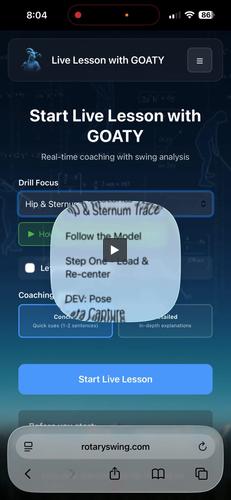
If you want to see how GOATY helps coach you to load properly in the backswing, check out the video below:
FAQ's:
Q. What is GOATY "seeing" in my swing compared to a human?
A. GOATY tracks over 50,000 data points in a single swing! Obviously, no human can track more than a handful. GOATY tracks not just how your body moves and the sequencing, but the velocity and tempo as well. He performs thousands of calculations during the analysis that involve complex algebra, geometry and probabilistic statistics that give him "X-ray-like" vision of your swing mechanics. And then he compares that to how the GOATs all swung and does it all in just seconds!
Q. Do I have to hit balls to use GOATY?
A. No! GOATY is designed to be used anytime, anywhere! That means you can practice indoors and still make progress no matter the time of year (or day, for that matter!). Imagine the jump you will get on your buddies practicing with an EXPERT coach every single day during the off season!
Q. How should I video my swing?
A. GOATY works best when you video at 120 frames per second, which most all modern phones do.
Q. What angle should I video my swing?
A. Face on only. GOATY is designed to teach you how to move like the GOATs (Greatest Of All Time) and that is best seen and measured from a face on view.
Q. Who is the GOAT Model based on?
A. The GOAT model is a mathematical model with ranges for each metric and was designed based on GOATY creator, Chuck Quinton's 35+ year study of the golf swings of the GOATs.
Q. What tour pro scores the highest?
A. Tiger Woods (depending on the era of his swing) scores the highest between 95-98 GOATScore. His early 2000s and 2019 swings score the highest.
Q. What club should I use?
A. GOATY is built around hitting a mid iron, 4-6 iron is perfect.
Q. Can I literally "talk" to GOATY?
A. Yes! GOATY can respond both verbally and in text, whichever you prefer and in any language!!
©2025 RotarySwing Golf, LLC